The State of the Extended Reality Markets and Technologies
Moore's Law and technology adoption curves aren't anything new at this point, and while there's complicated materials science that impacts the length of a product generation in extended reality (XR) products, we are seeing a doubling of key capabilities of these devices every 2.5 to 3 years. From that, we can make some guesses about when the devices will begin to see mass consumer adoption. Adoption curves lag far behind device capabilities, usually because of user interface or application utility. For personal computers, it was spreadsheets, and then communications. For smartphones, it was music and photography.
This post tracks market sizes and significant improvements in the devices themselves. We don't know what UI or applications will create adoption. We can at best guess what applications and communications will do with the devices, but they are guesses.
Market Sizes
As a term, Extended Reality (XR) covers devices ranging from fully immersive Virtual Reality (VR), to Mixed Reality (MR) to Augmented Reality (AR). The uses range from Heads Up Displays (HUD) on car windows or mirrors, to Head Mounted Displays (HMD). The technologies merge and diverge with each generation. With the addition of more and better external cameras on VR HMDs, VR and MR devices are beginning to merge, while AR devices are diverging into different types of HMDs and external devices like windows and mirrors. For my purposes, I'm mostly tracking markets, technology and applications for HMDs.
- Virtual + Mixed Reality HMD
- Augmented Reality HMD (glasses and headsets)
With VR and MR merging due to the addition of external cameras, and AR devices poking into the lighter side of MR along with the more traditional data overlay capabilities, there will continue to be market specialization in hardware. Real specialization does not occur until there is a large application market. Outside of gaming, and minor education, all the application software markets for XR are tiny. They are growing at a high CAGR - 30% to 45% - but still tiny. The CAGR numbers are guesses, as well. For now, hardware is still in its primitive phase, and I tend towards the lower numbers on application growth.
Hardware creates application markets, then applications drive hardware markets. Visicalc sold Apple IIe's, and photography and texts sold iPhones. Maybe Angry Birds and Bejeweled sold iPhones.
For tracking hardware, there are three numbers - all HMD, VR HMD, and AR HMD. For applications, I look at large categories - games, education, simulation, computer-assisted workplace applications.
Virtual Reality
This is nowhere near a mature market, which means the definitions of the revenue categories are iffy, and the gathered data may have a lot of conflicting sources. We're looking at two numbers as being important to the development of the application markets - installed device base, and device revenue.
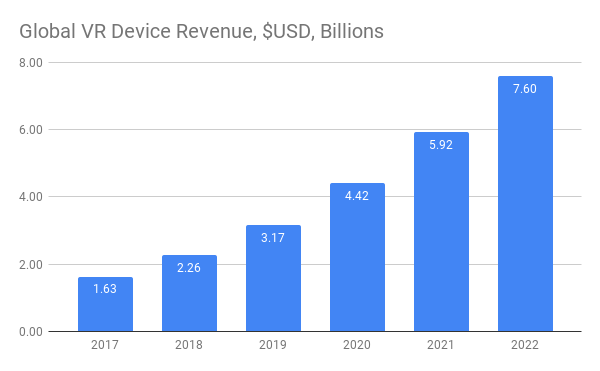
| Year | Revenue (billions) | Annual Growth |
| 2017 | $1.63 | |
| 2018 | $2.26 | 39% |
| 2019 | $3.17 | 40% |
| 2020 | $4.42 | 39% |
| 2021 | $5.92 | 34% |
| 2022 | 7.60b (est) | 28% (est) |
Overall market size - device and application.